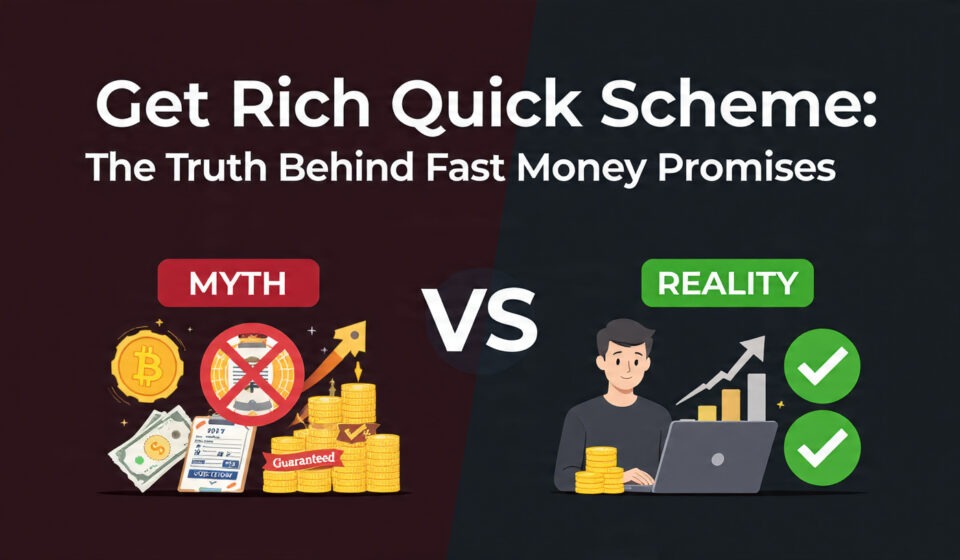

Get Rich Quick Scheme: The Truth Behind Fast Money Promises
Everyone dreams of financial freedom. The idea of making thousands of dollars in a matter of days or weeks is appealing, especially if you’re struggling with debt, trying to grow your savings, or simply looking for a better lifestyle. Unfortunately, this dream is exactly what scammers and dishonest marketers rely on.
A get-rich-quick scheme is designed to convince people that wealth can be achieved with little effort, minimal risk, and almost no experience. While the promises sound exciting, the reality is usually very different. Most participants either lose money or earn far less than they were led to believe.
The internet has made these schemes more widespread than ever. Social media influencers show luxury cars, expensive watches, and exotic vacations while claiming that anyone can achieve the same lifestyle by purchasing a course, joining an investment program, or recruiting new members. Some opportunities may appear legitimate at first glance, making it difficult to separate genuine businesses from scams.

What Is a Get Rich Quick Scheme?
A get rich quick scheme is any business opportunity, investment, or financial program that promises unusually high returns in a short period while downplaying or completely ignoring the risks involved.
These schemes often use persuasive marketing techniques such as:
- “Earn $10,000 in your first month.”
- “No experience required.”
- “Quit your job in just 30 days.”
- “Guaranteed profits with zero risk.”
- “Only a few spots remaining.”
The goal is simple: convince people to act quickly before they have time to think critically or conduct proper research.
In reality, legitimate investments always involve some level of risk. Successful entrepreneurs spend years building businesses. Professional investors study markets carefully before committing capital. Even highly profitable careers require education, experience, and consistent effort.
If someone claims they’ve discovered a shortcut that bypasses all these realities, it’s wise to be skeptical.
Why Do Get Rich Quick Schemes Work So Well?
One of the biggest reasons these schemes succeed is human psychology.
People naturally seek easier solutions to difficult problems. When faced with financial stress, the promise of quick wealth becomes even more attractive.
Scammers understand this extremely well.
Instead of focusing on facts, they focus on emotions.
Common emotional triggers include:
Financial Pressure
Someone struggling with bills or debt may become desperate for a solution. A fast-money opportunity appears to offer hope
Fear of Missing Out (FOMO)
Many promotions create artificial urgency by saying:
- Limited seats available
- Offer expires tonight
- Prices increase tomorrow
This pressure encourages people to make decisions without proper research.
Social Proof
Videos showing expensive lifestyles create the illusion that everyone else is succeeding.
Luxury homes.
Designer clothes.
Private jets.
Sometimes these items are rented solely for promotional content.
The audience assumes the business opportunity created this wealth, even when there’s little evidence supporting the claim.
Authority Bias
Some marketers claim to be:
- Millionaires
- Financial experts
- Successful investors
- Self-made entrepreneurs
While some genuinely are successful, others exaggerate their credentials to appear trustworthy.
Common Types of Get Rich Quick Schemes
Not every opportunity that promises high income is automatically fraudulent. However, many follow similar patterns.
Let’s look at the most common examples.
1. Pyramid Schemes
Pyramid schemes depend primarily on recruiting new members rather than selling real products or services.
Participants pay an entry fee.
They earn commissions only when they recruit others.
Those new recruits must then recruit even more people.
Eventually, recruitment slows down.
The system collapses.
Most participants lose money because there simply aren’t enough new recruits to sustain the structure.
2. Ponzi Schemes
A Ponzi scheme uses money from new investors to pay returns to earlier investors.
At first, everything appears legitimate.
People receive consistent profits.
Satisfied investors tell friends and family.
More money enters the system.
Eventually, new investments slow.
Without fresh money, payments stop.
The entire operation collapses.
Some of history’s largest financial frauds followed this exact model.
3. Fake Investment Platforms
Modern scammers often build professional-looking websites.
These platforms display:
- Live charts
- Account balances
- Trading history
- Fake profits
Victims believe their investment is growing.
When they attempt to withdraw funds, they encounter excuses like:
- Verification fees
- Tax payments
- Withdrawal charges
- Account upgrades
After paying additional fees, they still never receive their money.
4. Cryptocurrency Scams
Cryptocurrency is a legitimate technology.
However, scammers frequently misuse its popularity.
Examples include:
- Fake crypto exchanges
- Rug pull projects
- Pump-and-dump groups
- Guaranteed trading bots
- Fake mining investments
Many promise daily returns of 5% to 20%.
Such returns are generally unrealistic and financially unsustainable over the long term.
5. Lottery and Prize Scams
Receiving an email claiming you’ve won millions of dollars sounds exciting.
Unfortunately, these messages almost always request:
- Processing fees
- Taxes
- Bank information
- Identity documents
Legitimate lotteries don’t ask winners to pay upfront before claiming prizes.
6. Work-from-Home Scams
Remote work has become increasingly popular.
Scammers exploit this trend by advertising jobs that promise:
- $500 per day
- No qualifications needed
- Flexible schedule
- Immediate income
Applicants are then asked to purchase expensive training materials or starter kits.
After payment, communication often disappears.
7. Social Media Get Rich Quick Scheme “Investment Gurus”
Social platforms are full of self-proclaimed experts showing screenshots of massive profits.
Many use:
- Fake trading results
- Edited account balances
- Rented luxury cars
- Borrowed mansions
- Fabricated testimonials
Their real business isn’t investing.
It’s selling expensive courses, mentorships, or signal groups.
While some educators provide genuine value, others rely entirely on marketing rather than proven expertise.

The Biggest Myth About Fast Wealth
One of the most damaging beliefs promoted by get rich quick schemes is that successful people became wealthy overnight.
In reality, most successful entrepreneurs, investors, and professionals spent years developing skills, building networks, making mistakes, and improving their strategies.
The “overnight success” story often ignores a decade or more of hard work behind the scenes.
Whether someone builds a successful company, invests wisely, or creates a valuable service, sustainable wealth typically comes from patience, discipline, and consistent decision-making—not shortcuts.
This doesn’t mean rapid financial success is impossible. Some individuals do experience extraordinary gains through innovation, timing, or exceptional business opportunities. However, these cases are uncommon and almost always involve significant effort, risk, or both.
For the average person, focusing on long-term financial habits is far more reliable than chasing promises of instant riches.
Red Flags of a Get Rich Quick Scheme: How to Spot the Warning Signs
Not every investment opportunity or online business is a scam. In fact, many legitimate businesses can generate substantial income over time. The difference lies in how the opportunity is presented.
A genuine business explains both the potential rewards and the risks involved. A get rich quick scheme, on the other hand, focuses almost entirely on profits while hiding the reality.
Below are the most common warning signs.
1. Guaranteed Profits
One of the biggest red flags is a promise of guaranteed income.
You might see claims like:
- Guaranteed 300% returns
- Risk-free investment
- Earn money while you sleep
- Make $1,000 every day without effort
These statements should immediately raise concerns.
No legitimate investment can guarantee profits. Even experienced investors lose money on some trades. Stock markets fluctuate, businesses face unexpected challenges, and real estate values change over time.
Whenever someone promises certainty in an uncertain market, they’re often selling false hope rather than a genuine opportunity.
2. Pressure to Act Immediately
Scammers don’t want you to think.
Instead, they create urgency.
Examples include:
- Only five spots remaining
- Offer expires in two hours
- Last chance to become financially free
- Prices double tomorrow
This tactic prevents people from researching the company or asking difficult questions.
Legitimate businesses understand that customers need time to make informed decisions.
If someone refuses to let you think, that’s usually a warning sign.
3. Unrealistically High Returns
Consider this example.
A bank savings account may offer a modest annual return.
A diversified investment portfolio might generate reasonable long-term growth.
Now compare that with someone promising:
- 20% every week
- 10% every day
- Double your money in seven days
These numbers simply don’t align with how financial markets work.
If earning those returns were truly that easy, banks, hedge funds, and major investment firms would already be doing it at massive scale.
4. No Clear Business Model
Ask one simple question:
Where does the money actually come from?
If the answer is confusing, vague, or constantly changing, walk away.
Legitimate businesses generate revenue by selling products or services.
Scams often avoid explaining their revenue source.
Instead, they rely on buzzwords like:
- AI-powered investing
- Secret algorithm
- Exclusive insider strategy
- Private wealth system
- Automated profit engine
Fancy terminology cannot replace a real business model.
5. Recruitment Is More Important Than Sales
This is common in pyramid schemes.
Instead of focusing on customers, participants spend most of their time recruiting new members.
Income depends on bringing others into the system rather than providing genuine value.
Eventually, recruitment slows.
When that happens, the entire structure begins collapsing.
6. Hidden Information
A trustworthy company is transparent.
You should easily find:
- Company registration
- Physical address
- Customer support
- Leadership team
- Refund policies
- Terms and conditions
Scammers often hide behind anonymous websites, fake profiles, or messaging apps.
If you cannot verify who is operating the business, proceed with extreme caution.
Real Examples of Get Rich Quick Schemes
History provides countless examples of schemes that appeared successful—until they collapsed.
Ponzi Investment Programs
These schemes promise unusually high returns while using money from new investors to pay earlier participants.
Everything appears normal in the beginning.
Investors receive regular payouts.
Word spreads.
More people invest.
Eventually, new investments stop coming.
Without fresh money, payments cease, and the entire operation fails.
Thousands of people have lost their life savings through this model.
Fake Cryptocurrency Projects
The cryptocurrency industry has created exciting innovations.
Unfortunately, it has also attracted fraudsters.
Common examples include:
- Fake token launches
- Rug pulls
- Fraudulent NFT projects
- Fake exchanges
- Investment bots promising daily profits
Some projects disappear overnight after collecting millions of dollars from investors.
Others continue operating just long enough to attract additional victims before shutting down.
Online Trading Signal Scams
Many websites claim they can predict financial markets with near-perfect accuracy.
Typical advertisements include:
- 95% winning trades
- Guaranteed forex profits
- Secret institutional strategy
- Never lose another trade
Professional traders understand that losses are part of trading.
No strategy wins every time.
Anyone claiming otherwise is almost certainly exaggerating their results.
Fake Coaching Programs
Education has value.
Many successful professionals sell legitimate courses.
However, some “gurus” make far more money selling dreams than using the methods they teach.
Common warning signs include:
- Constant luxury lifestyle videos
- Little proof of actual business success
- High-pressure sales webinars
- Expensive mentorship programs
- Vague teaching with no practical application
Their primary income often comes from selling courses—not from the business they’re supposedly teaching.
Why Intelligent People Fall for Get Rich Quick Schemes
Many assume only inexperienced people become victims.
That’s incorrect.
Doctors, engineers, lawyers, business owners, and experienced investors have all lost money to sophisticated scams.
Scammers exploit psychology—not intelligence.
Here are some common factors.

Hope
Financial difficulties create emotional vulnerability.
People want solutions.
A promise of rapid financial improvement becomes highly attractive.
Trust
Victims often hear about opportunities through:
- Friends
- Family members
- Coworkers
- Religious communities
- Social media influencers
Trust transfers from the person making the recommendation to the opportunity itself.
Greed
Greed is a powerful motivator.
The desire to earn extraordinary profits can override logical thinking.
When emotions dominate decision-making, critical analysis often disappears.
Confirmation Bias
Once someone believes they’ve found a life-changing opportunity, they naturally seek information supporting that belief.
Warning signs become easier to ignore.
Positive testimonials receive more attention than critical reviews.
This reinforces poor decisions.
The Financial Cost of These Schemes
Money lost is only one part of the damage.
Victims often experience:
- Damaged credit
- Debt
- Broken relationships
- Loss of confidence
- Emotional stress
- Anxiety
- Depression
Some borrow money from friends or family to invest.
Others take personal loans.
When the scheme collapses, the financial burden can last for years.
How to Verify an Investment Opportunity
Before investing even one dollar, ask these questions.
Is the company legally registered?
Search official business records.
Verify licenses where applicable.
Are returns realistic?
If promised profits seem unbelievable, compare them with historical investment returns.
Extraordinary claims require extraordinary evidence.
Can you explain the business model?
If you cannot explain how the company generates revenue in one or two simple sentences, you probably shouldn’t invest.
Can you withdraw your money?
Test the withdrawal process before investing significant amounts.
Many fraudulent platforms make deposits easy but withdrawals impossible.
Has the company been independently reviewed?
Look beyond testimonials on the company’s own website.
Search for reviews from independent sources, consumer protection forums, and reputable financial publications.
A lack of credible information—or a pattern of unresolved complaints—should prompt further caution.
Questions to Ask Before Investing
Whenever you’re presented with an opportunity, pause and ask:
- Who makes money if I join?
- Where do the profits come from?
- What are the actual risks?
- Is there independent evidence supporting these claims?
- What happens if no new customers join?
- Can I verify the company’s legal status?
- Would I still invest if someone removed all the luxury marketing?
If the answers remain unclear, it’s usually better to walk away than to gamble with your finances
What is a get rich quick scheme?
A get rich quick scheme is a business opportunity, investment, or financial program that promises large profits in a short period with little effort or risk. These schemes often rely on misleading advertising, unrealistic income claims, or deceptive tactics to attract participants. In many cases, people lose money instead of earning the promised returns.
Are all get rich quick schemes illegal?
Not all get rich quick schemes are technically illegal, but many operate in unethical or fraudulent ways. Some may exploit legal loopholes, while others are outright scams such as Ponzi schemes or pyramid schemes. Before investing, always verify the company’s legitimacy and understand how it generates revenue.
How can I identify a get rich quick scheme?
Some of the most common warning signs include:
Guaranteed profits with little or no risk
Pressure to invest immediately
Unrealistically high returns
Lack of transparency about the business model
Heavy focus on recruiting new members
No verifiable company information
If an opportunity sounds too good to be true, it usually deserves careful investigation.
Why do people fall for get rich quick schemes?
People are often attracted by the promise of financial freedom, especially during times of financial stress. Scammers also use psychological tactics such as urgency, fear of missing out (FOMO), social proof, and luxury lifestyle marketing to make their offers appear credible.
Are cryptocurrency investments always get rich quick schemes?
No. Cryptocurrency itself is a legitimate asset class and blockchain technology has many real-world applications. However, scammers frequently use cryptocurrency to promote fake investment platforms, fraudulent token launches, and unrealistic profit guarantees. Always research a project carefully before investing.
Can you become rich quickly through investing?
While some investors achieve exceptional returns, there are no guaranteed shortcuts to wealth. Successful investing typically requires patience, risk management, diversification, and a long-term strategy. Anyone promising guaranteed fast riches should be viewed with skepticism.
What should I do if I think I’ve joined a get rich quick scheme?
If you suspect you’ve been targeted by a scam:
Stop sending additional money.
Save all emails, messages, and payment records.
Contact your bank or payment provider immediately.
Report the incident to your local consumer protection or law enforcement agency.
Warn friends or family if they may also be at risk.
Taking action quickly may improve the chances of recovering funds, although recovery is not always possible.
Can social media influencers promote get rich quick schemes?
Yes. Some influencers knowingly or unknowingly promote questionable investment opportunities, trading groups, or business programs in exchange for commissions. Always research an opportunity independently instead of relying solely on endorsements from influencers.


